
A Stronger Democracy: An Investor’s Guide

Why Invest In Democracy?
A well-functioning democracy supports economic stability and gives institutions the credibility they need to govern effectively over time. When democracy weakens, policymaking becomes harder and confidence in public institutions starts to break down. Today, only 17% of Americans report trusting the federal government to do what is right most of the time, near historic lows.
Democratic strain affects the systems that enable markets, communities, and public institutions to function effectively. It also creates demand for solutions that strengthen institutional trust, improve public systems, and expand access to the economic, civic, and information infrastructure that supports democratic participation.
Across our research, we see an emerging investment landscape shaped by infrastructure gaps, technology modernization, and the need to rebuild trust at scale. The opportunity set spans both core democracy infrastructure and the broader conditions that enable democratic participation.
Our coverage reflects meaningful asymmetry: as of February 2026, CapShift’s Research Engine includes 400+ democracy-adjacent opportunities, compared with 20+ strategies focused on strengthening core democratic infrastructure. This distinction matters because the two differ materially in scale, investability, risk, and capital fit.
What Does the Democracy Investment Landscape Look Like?
We separate the democracy investment landscape into two interdependent layers:
- “Upstream” solutions are those that create the structural conditions that shape democratic participation and institutional capacity.
- “Downstream” infrastructure refers to the operational systems that administer governance, elections, public services, rights delivery, and information flows.
Upstream determinants include areas like economic opportunity, connectivity and digital inclusion, social cohesion, and criminal justice. These are generally larger and more familiar markets, which often overlap with sectors investors already understand. Compared to pure-play democracy infrastructure, upstream solutions also represent a deeper and more scalable opportunity set, though return profiles vary by strategy and capital structure. Downstream infrastructure encompasses technologies and systems that support elections and democratic integrity, citizen experience and rights delivery, as well as media and freedom of the press. This is a more specialized part of the market that can be harder to navigate. As a result, investments in downstream infrastructure may require careful matching between opportunity type and capital structure.
Some downstream models can support venture-style or market-rate investment, particularly where companies provide scalable solutions in areas like election administration, CivicTech, GovTech, public-service delivery, cybersecurity, compliance, or information integrity. Other areas, including local media, press freedom, and some civic infrastructure, where commercial capital alone is less effective, may require impact-first or blended-capital approaches. Across this layer, investors need to account for procurement and regulatory friction, uneven budgets, certification requirements, and demand that can spike around election cycles or moments of crisis.
In practice, the two layers are closely linked. Upstream conditions shape who can participate and how much capacity institutions have to serve the public. Meanwhile, downstream systems determine how reliably elections, public services, rights delivery, and information flows operate. Democratic performance depends on how well these systems reinforce one another — which is why investment opportunities across both layers should be evaluated together rather than in isolation.
Framework: The Two Layers of Democratic Infrastructure
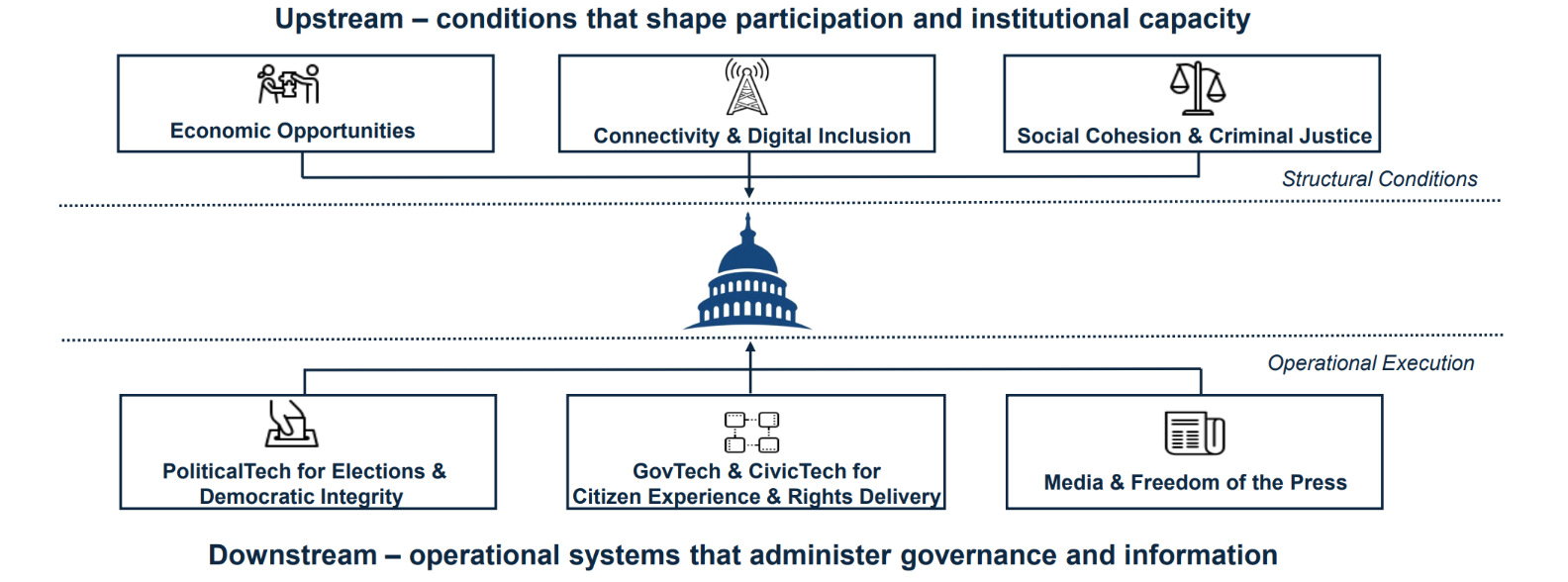
Source: Internal research framework. Categorization is analytical; individual opportunities may span both layers.
What Is Driving Opportunity?
Three forces shape the strength of a democracy: institutional trust, access to public and economic systems, and information integrity. Each point to a different set of investment needs.
1. Trust in Institutions
Trust in institutions directly affects how the economy functions. Increasing trust can allow governance to become more effective: policies are easier to implement, compliance can improve, and public spending may have greater impact.
Service delivery is one place where this shows up. Clearer digital platforms for election information, benefits navigation, and public-service delivery can help citizens find information, access services, and engage with government more easily.
For investors, the relevant opportunity is the infrastructure behind better service delivery. This includes tools that support benefits navigation, case management, compliance, constituent engagement, and workflow modernization. Companies that build more transparent, accountable, secure, and reliable systems may be better positioned to sustain adoption across political and regulatory cycles, particularly when their products are embedded in essential public workflows.
2. Access to Civic and Economic Systems
Another area of opportunity is access. Structural barriers can prevent individuals from fully participating in civic processes, public benefits, and economic systems. These barriers extend across both elections and public services: while the 2020 election saw voter turnout increase to 66%, participation remained uneven, with only 47% turnout among eligible voters ages 18 to 29.
Beyond elections, gaps in public benefits access remain significant, with nine million adults over 65 eligible for but not enrolled in programs that would help cover the cost of food, medicine, and other expenses.
Access is not only about whether someone can vote or navigate public services. It is also about whether people have the stability, resources, and connectivity to participate more fully over time. That includes affordable housing, small business finance, workforce pathways, healthcare, and other conditions that support civic, political, and economic participation. Strengthening these conditions can expand participation over time.
3. Misinformation, Influence, and Information Systems
The digital information environment has become a major destabilizing force for democracy. Platform algorithms can amplify polarizing content, while local information ecosystems continue to erode. Roughly 2,500 local newsrooms have closed over the past decade, leaving more than 50 million Americans with limited access to credible information about their communities.
This creates two areas with different investment needs: technology and independent media. Tools that detect misinformation, verify content, show where content came from, and support AI governance may be able to scale through enterprise or public-sector customers. Local news, press freedom, and community information systems often need philanthropic, concessionary, or blended capital because their revenue models are usually too constrained for market-rate capital alone.
What Are Some of the Risks?
Investing in democracy-related sectors comes with a different set of constraints than most markets. Many of the risks are structural rather than company-specific, which means portfolio construction and capital structure tend to matter as much as individual underwriting. Some of these constraints can also create defensibility: procurement complexity, certification requirements, compliance needs, and public-sector relationships can slow adoption, but they may also reduce competitive intensity once a provider is embedded.
Risk Matrix
| Factor | Risk | Mitigation |
|---|---|---|
| Market | Democracy-related markets are fragmented across public-sector buyers, with long procurement cycles, uneven budgets, and demand that can spike around election cycles or moments of crisis. As a result, many CivicTech, GovTech, and election-adjacent solutions may struggle to scale or deliver traditional venture-like returns without diversified revenue models or recurring contract structures. | Diversify exposure across states, municipalities, and regulatory regimes to reduce concentration risk, and balance earlier-stage innovation with later-stage or more stable initiatives. |
| Policy | Democracy-related sectors operate under heightened scrutiny, and changes in political leadership or regulatory frameworks can materially affect demand, funding, and compliance requirements. Political polarization can also create backlash against technologies perceived as partisan or intrusive. | Favor non-partisan, infrastructure-oriented providers that support transparency, access, security, and service delivery; prioritize strong compliance capabilities, governance practices, neutrality, and auditable systems. |
| Return | Many solutions depend on public budgets, grant funding, limited willingness to pay, or quasi-commercial markets, which can constrain margins, scale, and exit pathways. | Prioritize companies with diversified and recurring revenue models; use blended capital, guarantees, or anchor customers where appropriate. |
| AI and Digital | Rapid AI and digital advances introduce risks related to bias, misuse, obsolescence, data privacy, cybersecurity, and system failure. In democracy applications, these risks carry amplified reputational and systemic consequences. | Prioritize transparency, auditability, human oversight, data governance, cybersecurity resilience, and ongoing model monitoring. |
Source: Internal research analysis. Risk characterizations are qualitative and sector-level; individual investments require independent assessment.
How Can Different Investors Participate?
Capital across the spectrum have a part to play in strengthening democracy. Market-rate returns may be found in larger upstream markets, government technologies, broadband, digital infrastructure, and select information-integrity strategies. Philanthropic dollars and blended-capital structures can be especially important in parts of the market where commercial capital alone may be less effective, including local media, press freedom, early-stage civic technology, and community information systems.
Allocating investments with a democracy objective requires a degree of complexity. Targeted interventions work best when engaged across the layers of upstream determinants and downstream infrastructure. This may also mean pairing market-rate investments with concessionary or catalytic capital.
Financial returns and impact may also move on different timelines. Clients with fixed return expectations or narrower mandates may need to focus on the parts of the landscape where the capital structure, revenue model, and impact objective are already aligned.
Conclusion
Democracy is increasingly being treated as infrastructure that requires continuous investment and maintenance. For investors, the question is less whether the need exists and more where capital can be applied effectively.
This is not a conventional market. Returns will likely be uneven and timelines are often longer than expected. But demand for solutions that improve public systems function is growing, particularly as institutional trust comes under pressure. Investors who spend time understanding how capital moves across this landscape may be better positioned as that demand continues to build.