
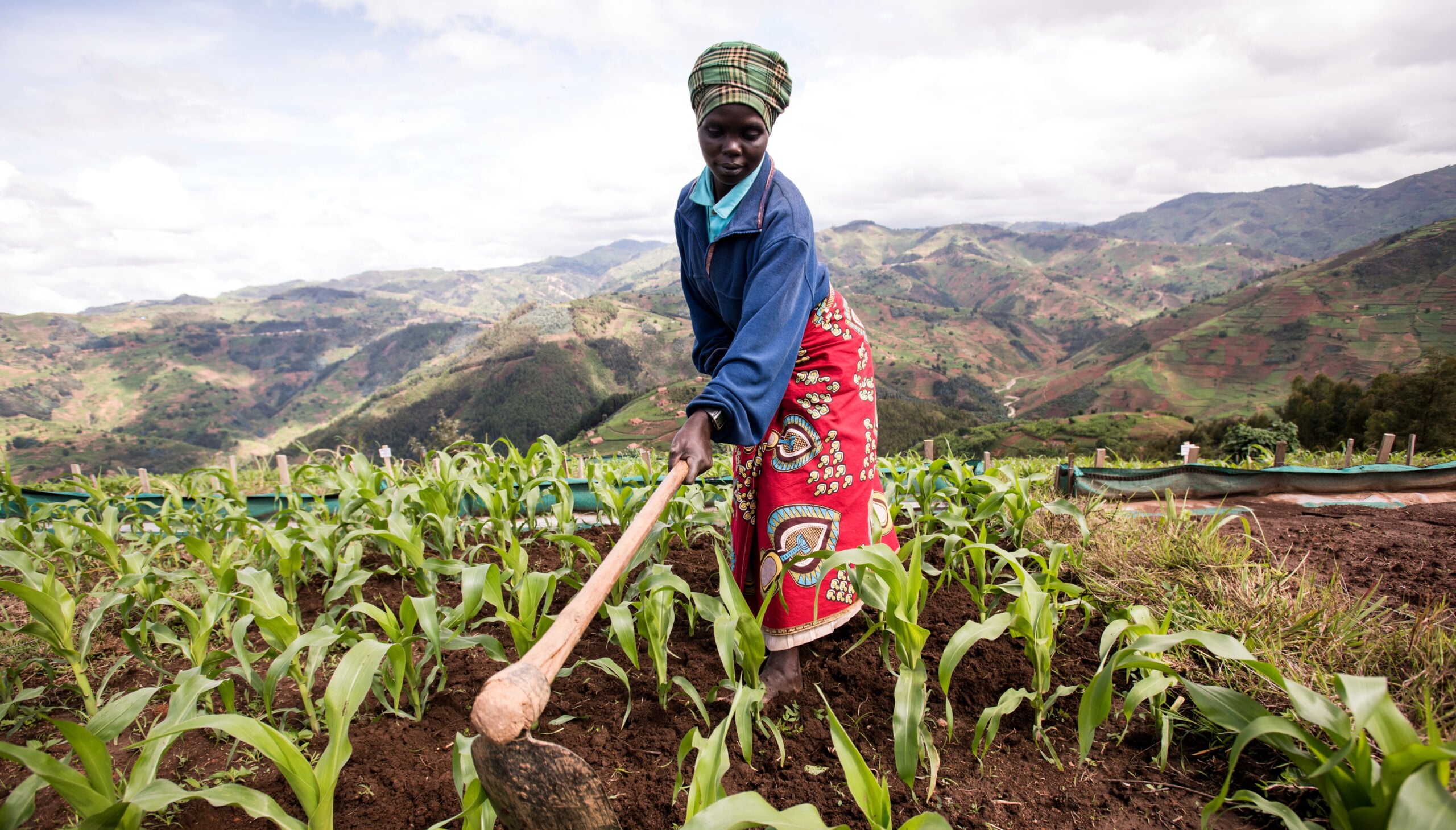
Recoverable grants help finance the cost of farm inputs for One Acre Fund clients like Beatrice in Rwanda pictured here (Image Credit: One Acre Fund).
A donor’s perspective on using flexible, recoverable capital to deepen impact
As a donor, I’m always looking for ways to make my philanthropic dollars go further. At Ezrah Charitable Trust, we are passionate about expanding economic opportunity. We focus our philanthropy in Africa, supporting organizations that help families grow their incomes and build more secure futures.
Part of our giving journey has been learning how different tools can help expand our impact — allowing our dollars to work harder and giving the organizations we support greater flexibility to grow. That exploration led us to recoverable grants, a powerful complement to traditional grantmaking, that enables capital to have the potential to be recycled and redeployed for impact.
Recoverable grants can offer both donors and nonprofits more flexibility, as some or all of the funds may be recovered to the donor if the organization meets established goals — for example, if a program hits revenue or outcome milestones.
Why Consider Recoverable Grants?
Many nonprofit social enterprises, even established ones, operate in environments where cash flow timing — not long-term sustainability — is the primary constraint. This is especially true for organizations serving communities with seasonal income patterns. They must purchase goods or deliver services, often months before revenue is realized.
Traditional grants are essential for program innovation and serving high-need communities. At the same time, organizations with proven models may struggle to access flexible, affordable capital to manage predictable working capital needs. Recoverable grants help bridge that gap.
For donors, recoverable grants offer a chance to provide patient, risk-tolerant capital that can be used and then potentially repaid, and redeployed to help expand the reach of the innovations that traditional grants are funding.
A Case Example: Working Capital for One Acre Fund’s Farmer Programs
Our own exploration of recoverable grants began through our long-standing partnership with One Acre Fund, a nonprofit social enterprise we have supported since 2018. Over the years, we’ve given a number of traditional grants — from testing and scaling technology innovations, to extending financial relief to farmers during COVID, to supporting the organization’s most recent five-year strategy focused on scale. This history of trust and shared vision made us open to exploring how a recoverable grant might complement our existing support.
One Acre Fund’s model requires buying seed, fertilizer, and other life-improving products before the planting season, and then offering these products to farmers on credit with flexible repayment aligned with growing seasons. On average, farmers increase their farm income by 35%, and can repay One Acre Fund in full after harvest season, which is often up to almost a year later.
This creates a natural timing gap: organizations like One Acre Fund must pay suppliers upfront, but farmer repayments arrive many months later. For any mission-driven enterprise serving millions of low-income families, this cash conversion cycle can be a bottleneck. Recoverable grants are well-suited to bridge that gap, enabling organizations to reach more clients than they would be able to using grants alone.
How Making a Recoverable Grant Worked
Administratively, recommending a recoverable grant from my donor-advised fund (DAF) was very similar to recommending a grant. One Acre Fund receives risk-tolerant working capital upfront, uses it to purchase inputs to sell to farmers on credit, and repays the funds if farmers repay after a set period of time.
So, while our traditional grants fund the value-added services that One Acre Fund delivers to farmers (e.g. training, digital advice), a recoverable grant can be used to fund the financing of the products that One Acre Fund delivers to existing and new farmers to their program.
We chose a three-year term for our recoverable grant. The capital will be used to extend products on credit to farmers for three seasons. At the end of the three years, if One Acre Fund meets its revenue milestones, the funds will be recovered to my DAF, plus a modest additional recovery payment, where I can choose to redeploy it, either as a grant or another recoverable grant.
Reflections for Fellow Donors
What has stood out to me most is how recoverable grants allow donors to support not just what organizations do, but how they do it. Through recoverable grants, I’ve been able to support not only One Acre Fund’s programs, but also the financial backbone that makes those programs possible.
If you have a donor-advised fund, I encourage you to explore whether recoverable grants could complement or extend the impact of your giving. It’s simpler than it sounds, and for me, it has been one of the most practical and rewarding ways to amplify and enhance my giving. I’d love to see more donors put their dollars in motion this way.
Disclosure
This article was written by a third-party not affiliated with CapShift and is presented for educational purposes only. This article should not be construed as investment advice or a recommendation. CapShift has not verified the accuracy or completeness of the information presented. CapShift does not necessarily agree with all opinions expressed by the author.