

If you’re like most advisors, your first reaction to impact investing likely involved some skepticism about the tradeoffs that would be required.
What will returns actually look like?
What are we giving up to get the impact?
Those aren’t the wrong questions to ask. But they’re not always the right assumptions to start from, either.
In fairness, there’s a reason this framing is so persistent. Impact investing has roots in the philanthropic sector and media coverage on impact investing often frames it as adjacent-to or part of philanthropy.
For many advisors, “impact” has been mentally filed as a strategy that only includes below market-rate opportunities.
However, the impact market has evolved, and for many advisors, impact investing is due for a re-introduction.
A Spectrum: Not Impact vs. Returns
Impact investing is not a single strategy, but many different strategies that fall on a spectrum between traditional investing and grantmaking.
A useful reframe for advisors to keep in mind is that impact investing spans a range of return expectations and most of the impact sector targets market-rate returns (read on to find out more).
A simple way to visualize this:
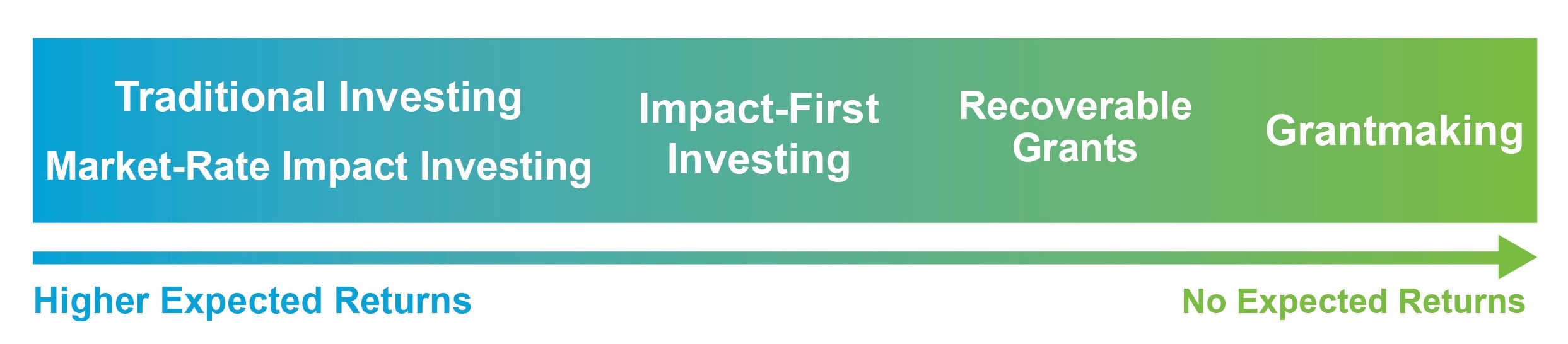
Each type of investing or grantmaking on the spectrum has a purpose. An advisor’s role is to help clients understand where they want to sit and when to sit there, not to present a false binary of “impact or returns.”
Mostly Market-Rate
The Global Impact Investing Network (GIIN) estimates that as of 2024 more than 3,900 organizations managed $1.57 trillion in impact investing assets. As of 2025, according to the GIIN’s 2025 State of the Market report, impact AUM of those surveyed grew at a compound annual growth rate of 21% over a six-year period. Many of the institutional investors driving much of this growth like pension funds, insurance companies, sovereign wealth funds – generally target – market-rate returns. In fact, more than three-quarters (79%) of impact investors surveyed in 2025 were seeking risk-adjusted, market-rate returns. To think of impact investing as purely concessionary would be misaligned with a majority of the industry.
Beyond targeting market-rate returns, impact often delivers them. When looking at performance, 72% of investors were satisfied with the financial performance of their impact investments.
When Impact-First Is the Right Tool
Impact-first has a purpose and can be a deliberate and valued part of a portfolio. An important aspect of this strategy is seeking out investments that are not risk-return adjusted by traditional definitions, but are seeking additional impact as a third dimensional trade-off is a conscious choice. We see impact-first investments with a range of financial and operational risk profiles, just like we would in the market-rate sector. Investors may choose to be more tolerant of a particular risk because of the constraints facing the sector where they seek to have an impact.
Reframing the Returns Conversation on Impact Investing
It is important for advisors to reframe their thinking around impact to better present impact options to their clients. Understanding the impact spectrum and the many market-rate and impact-first options available within the landscape enables advisors to incorporate their clients’ values into their work. This enhances the conversations that advisors are already having about time horizons, risk tolerance, return expectations, and purpose, with impact as one more dimension.
See our guide for more ideas on how to start this conversation with clients.