
Water Under Pressure: An Investor’s Guide to Climate Risk, Infrastructure, and Access
Why does water matter?
Water is foundational infrastructure and its fragility is becoming increasingly visible in economic data, municipal budgets, and daily headlines.
As climate pressures intensify and infrastructure gaps widen, the cost of continued underinvestment in water could compound. For investors, the opportunity is not simply to allocate more capital to water, but to deploy it with discipline, realism, and an impact lens that reflects how the system actually functions.
Those who do so may be positioned not only to manage risk, but to support resilience and access in one of the most essential sectors of the global economy.
What does the global water market look like?
Globally, roughly 70% of freshwater withdrawals are tied to agriculture, approximately 20% to industry, and about 10% to municipal and household use. These are not discretionary sectors, and thus, do not scale down easily in response to rising prices or supply volatility. Water users continue to absorb risk until systems fail, which is cause for global concerns as the demand for water only increases alongside population and economic growth.
At the same time, water supply reliability is deteriorating due to exogenous factors. Climate-driven droughts and floods are occurring with greater frequency and severity. Infrastructure built for historical conditions is now managing extremes it was never designed to handle. Practically, the water challenge increasingly shows up in three forms: too little water, too much water, and water that is unsafe, often within the same system.
The investment implications of these factors is visible. In the United States, funding needs for drinking water and wastewater infrastructure are expected to increase from roughly $110 billion in 2024 to nearly $195 billion by 2030. Similar dynamics are emerging across developed markets, while emerging markets face even steeper gaps due to rapid urbanization and limited fiscal capacity to increase or improve critical water infrastructure and systems. As such, there is a growing role for private and impact-oriented capital in structuring, aggregating, and financing water-related projects that public balance sheets cannot or have not absorbed.
What types of water investments are available?
Where capital does deploy, it concentrates in a small number of familiar patterns. The table below summarizes how investors are engaging with water in practice, and where constraints still limit scale.
| Where capital shows up | What investors are actually supporting | What works for investors | Where it breaks |
|---|---|---|---|
| Large-scale infrastructure | Regulated water and wastewater assets, desalination, flood protection | Predictable cash flows; fits existing infrastructure underwriting | Returns capped by regulation and political constraints |
| Operating platforms | Companies that manage, aggregate, or service multiple water assets | Diversification and scale matter more than single assets | Contracts and counterparties drive outcomes |
| Water technology | Tools embedded in systems (monitoring, treatment, efficiency) | Real cost savings when adoption happens | Sales cycles are slow; scaling is uneven |
What stands out across observed allocations is a preference for structures that reduce exposure to political risk, tariff sensitivity, and single-asset concentration.
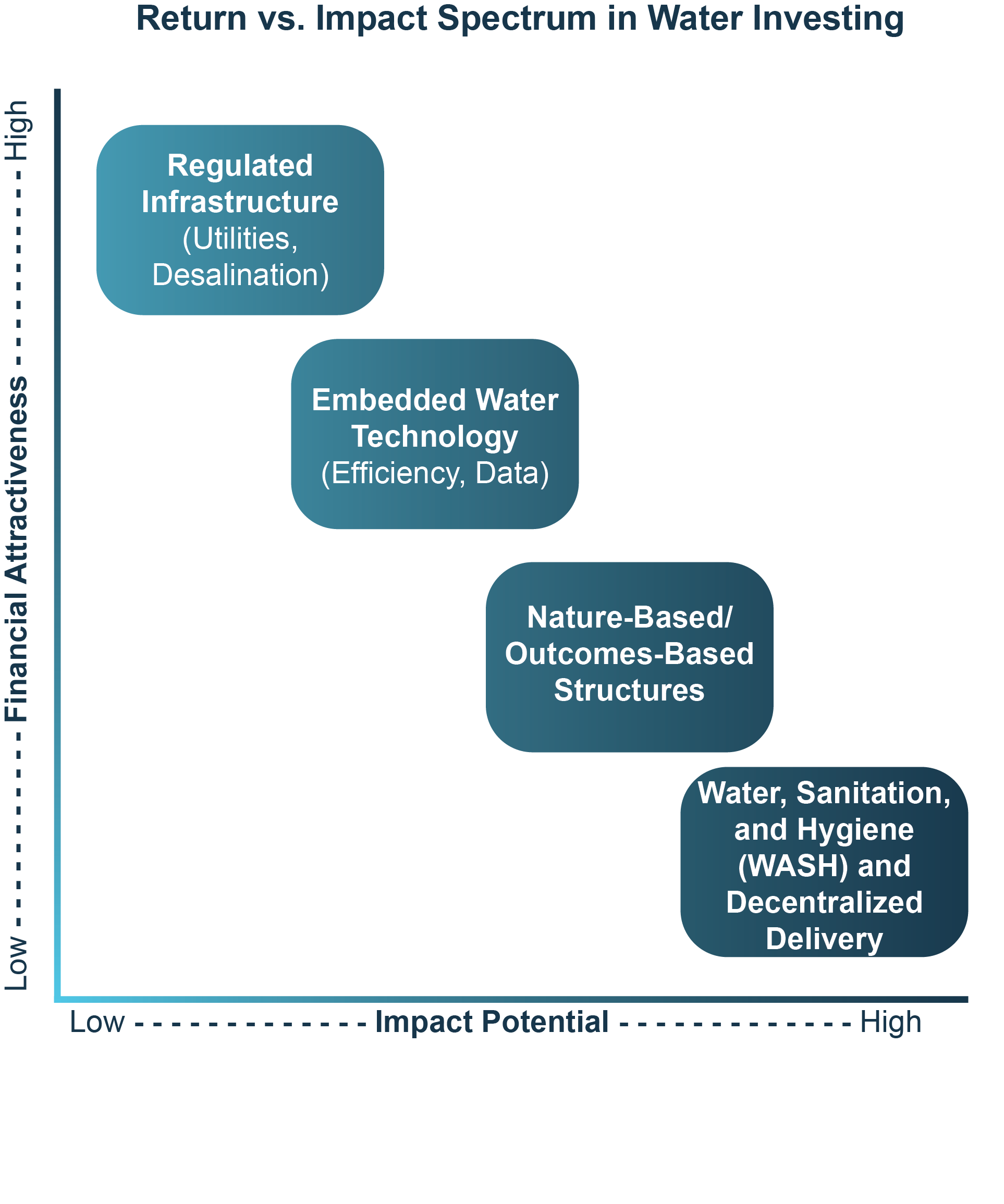
(This assessment draws on CapShift’s synthesis of research, diligence, and market observation and represents a snapshot in time. The framework is broadly indicative; specific investments within each structure can vary materially in risk/return profile and impact potential and require individual assessment. This framework does not intend to predict winners or recommend allocations, but to help investors understand how different forms of capital typically engage across water investment structures. See Appendix for methodology.)
How to read this framework?
The framework evaluates water investment structures along two dimensions:
- Financial attractiveness reflects how investable a structure is under current market conditions, based on qualitative factors such as revenue visibility, regulatory exposure, counterparty strength, and availability of financing pathways.
- Impact potential reflects the degree to which a structure can contribute to improved water outcomes (e.g., reliability, quality, access, resilience) at a system level, adjusted for potential downside risks.
How do water opportunities differ?
- Large-scale infrastructure: Centralized water assets account for the majority of capital deployed and underpin system performance. Returns are driven less by demand growth than by governance, including fee mechanisms, inflation indexation, and political risk management. Desalination illustrates this dynamic. Once marginal, it is now a core component of national water strategies in water-scarce regions. Morocco’s plan to source roughly 60% of its drinking water from desalination by 2030 reflects a broader shift underway across the Middle East and Southern Europe. For investors, these assets can be durable where energy inputs, permitting, and brine management are explicitly addressed; where they are not, assets struggle.
- Water, sanitation, and hygiene (WASH) and decentralized delivery: Decentralized supply and non-sewered sanitation address gaps where centralized networks cannot scale quickly or economically, particularly in fast-growing and underserved markets. The investment constraint is not demand, but affordability and aggregation. Water.org’s work in India and East Africa illustrates how this can be addressed, with partnerships enabling households to finance water and sanitation access at high repayment rates. These models emphasize service-based revenues and disciplined capital structures and typically target modest but resilient returns. Approaching WASH as purely philanthropic often obscures scalable delivery platforms with durable impact.
- Nature-based solutions: Nature-based investments can improve water quality and reduce flood risk at lower system cost but rarely generate direct user fees. Value accrues through avoided treatment costs and reduced asset and insurance losses. The West Yorkshire Pension Fund’s minority stake in Rebalance Earth provides a practical example, with “nature as a service” contracts monetizing flood risk reduction and water quality improvements for downstream beneficiaries. Capital in this segment is most effective when structured around outcomes rather than assets, with return profiles that are blended or impact-oriented by design.
What role does technology play?
In water, technology rarely stands alone as an asset class. Its value is realized when embedded into infrastructure, service platforms, and utility operations.
The most compelling water technology strategies are not consumer-facing or speculative, but are embedded in operational systems. Recent venture-backed approaches focus on reducing non-revenue water through advanced leak detection and pressure management, lowering energy and chemical use in wastewater treatment through membrane innovation, improving incident response using external data inputs, and generating power from existing water infrastructure through in-conduit hydropower.
What these strategies share is a clear economic value proposition for utilities or industrial users. Environmental benefit alone is rarely sufficient to drive adoption at scale. The growing number of specialist venture funds l focused exclusively on water, like Burnt Island Ventures, XPV Water Partners, and Emerald Technology Ventures, reflect increasing investor recognition of these opportunities, even as exit timelines remain longer than in other climate sectors.
What these strategies share is a clear economic value proposition for utilities or industrial users. Environmental benefit alone is rarely sufficient to drive adoption at scale. The growing number of specialist venture funds focused exclusively on water reflect increasing investor recognition of these opportunities, even as exit timelines remain longer than in other climate sectors.
How do different investors participate?
| Investor Type | Investment Type | Time Horizon | Risk / Return |
|---|---|---|---|
| Private Wealth Clients |
|
3–10 years | Medium to High |
| Charitable Donor-Advised and Foundations |
|
5–15 years | Low to Medium* (*often impact-first) |
| Institutional / Multilateral |
|
10–20 years | Low to Medium |
What distinguishes experienced allocators is how they balance exposure across these categories to manage political risk, time horizon, and impact objectives.
What are the specific considerations for investing in water in emerging markets?
In emerging markets, water stress is often more acute and more visible, driven by rapid urbanization, population growth, and climate exposure, alongside higher affordability constraints and institutional risk. Successful investment approaches in these markets tend to back scalable operating platforms rather than standalone assets. This is illustrated by WaterEquity’s Water & Climate Resilience Fund, which committed $5 million to SunCulture’s parent company to scale solar-powered irrigation pumps that rural households across Africa, Asia, and Latin America use for agriculture as well as daily drinking, cooking, and cleaning.
What are characteristics of resilient water investments?
Durable water investments are defined by structure, not essentiality. Across segments and geographies, the most resilient opportunities share a common set of characteristics:
- Identifiable payor with contractual or quasi-contractual payment obligations
- Revenue mechanisms insulated from political intervention, such as indexed tariffs, availability payments, or service-based fees
- Clear, measurable performance metrics tied to cash flow, not technology deployment alone
- Design assumptions aligned with future climate conditions, rather than historical norms
Where these elements are absent, underperformance is common. Essential services do not guarantee payment, and technology adoption is rarely rapid without institutional support. For many experienced allocators, durability in water is defined less by return maximization and more by capital preservation alongside long-term service delivery.
Conclusion
As investors evaluate how water fits within broader portfolio objectives, the challenge is not identifying opportunity, but structuring exposure in a way that reflects real-world constraints. We continue to see growing interest in strategies that balance durability, downside protection, and impact across water-related investments.
Appendix: Methodology and Limitations
Methodological note
This framework is based on CapShift’s qualitative synthesis of public research, diligence, and transaction experience across water-related investments globally. Categories reflect commonly observed investment structures rather than discrete asset classes. Placement reflects typical underwriting considerations and capital participation patterns, not asset-level performance or forward-looking projections.
The framework does not rely on a single dataset, does not represent an empirical ranking exercise, and should not be interpreted as a guarantee of outcomes. Actual investment results will vary materially based on geography, governance, structure, and execution.
Financial attractiveness scoring (illustrative rubric)
Score 1: Revenue mechanisms are fragmented or uncertain; high reliance on concessional or philanthropic support; limited standardization or replicability; elevated exposure to policy, affordability, or political risk.
Score 2: Demonstrated technical and operational viability with emerging financing pathways; investability is structure-dependent and sensitive to counterparties, aggregation, or permitting.
Score 3: Established underwriting approaches and recurring financing pathways; clearer revenue visibility (regulated, contracted, or service-based); attracts market-rate capital with relatively lower structuring friction.
Impact potential scoring (illustrative rubric)
Score 1: Delivers incremental or localized benefits but does not materially shift system-level reliability, resilience, or access.
Score 2: Provides meaningful improvements for specific regions, populations, or system nodes, but scaling is constrained by geography, affordability, or institutional capacity.
Score 3: Capable of contributing to system-scale improvements in water reliability, quality, access, or resilience with replicable pathways across contexts.
Impact potential may be downgraded where material risks exist, including unintended environmental harm, inequitable access outcomes, or system-level reliability concerns.
About the Author
Garima Gupta is a Manager of Impact Investments at CapShift. She collaborates with the investment research team and advisory practice to identify and assess investment opportunities aligned with social and environmental impact goals. Prior to joining CapShift, Garima practiced law in India. She holds a Master of International Business from The Fletcher School at Tufts University with a concentration in social finance.