
FemTech: An Investor’s Guide to the Intersection of Women’s Health, Technology, and Health Equity

What is FemTech?
FemTech, short for Female Technology, was coined by Ida Tin, a Danish entrepreneur and founder of the period tracking app Clue, back in 2016. The term refers to a category of software, diagnostics, products, and services that uses technology to improve women’s health across all stages of life. It encompasses areas including menstrual health, fertility, menopausal health, and general conditions impacting women and anyone with female organs, aiming to improve health outcomes and economic wellbeing.
What is the state of the FemTech market?
The global FemTech market is experiencing a surge, currently valued at ~$51 billion and poised for a 9% annual growth rate in the coming decade. This growth is fueled by several factors— from women’s health issues gaining much-needed awareness, advancements in technology creating innovative solutions, and finally, regulatory support (e.g., the US response to the overturning of Roe v. Wade).
In the US, key initiatives like the White House Initiative on Women’s Health Research and the Menopause Research and Equity Act allocate significant funding for comprehensive women’s health research and raise awareness about menopause, a condition with a substantial economic impact, largely due to lost working time.
FemTech solutions address a broad spectrum of women’s health needs, from fertility and pregnancy to mental wellness and sexual health. Examples include fertility tracking apps, prenatal care tools, hormone replacement therapies, mental health apps, pelvic floor trainers, at-home diagnostic kits, and medical devices for labor and delivery. The rise of telemedicine further fuels this growth, making healthcare solutions more accessible and convenient for women. FemTech presents a wealth of opportunities for innovation and investment. By addressing the unique health needs of women, this sector is poised to play a critical role in improving women’s well-being and creating a more equitable healthcare landscape.
Why is FemTech important?
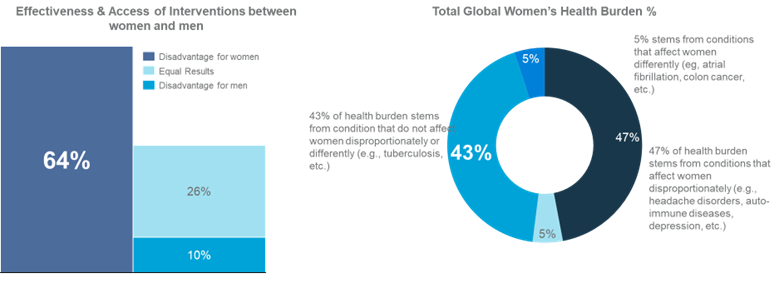
Women’s healthcare faces a crisis. Disparities plague the system, from the effectiveness of treatments to limited access to care. A recent McKinsey study found that across the 64 health conditions representing ~90% of the health burden for women, 64% of interventions were found to put women at a disadvantage due to lower efficacy or more limited access compared to just 10% for men. Underlying biases within the medical system itself further disadvantage women, who already carry a heavier burden of disease (nearly half stemming from conditions like autoimmune diseases and depression that more greatly impact women). Despite comprising over half the population, women’s health receives an inadequate amount of research funding – a mere 4% of biopharmaceutical research and development dollars. This lack of investment translates directly to a lack of medications designed for women’s specific needs. In 2022, only two out of 37 FDA-approved drugs addressed female-specific conditions.
Source: McKinsey
These disparities are only further exacerbated by race. Black women are 3-4 times more likely to die in pregnancy and 5 times more likely to die from pregnancy-related cardiomyopathy and blood pressure disorders than white women. Black women reach menopause 8.5 months earlier than white women and die from breast cancer at a 40 percent higher rate than white women.
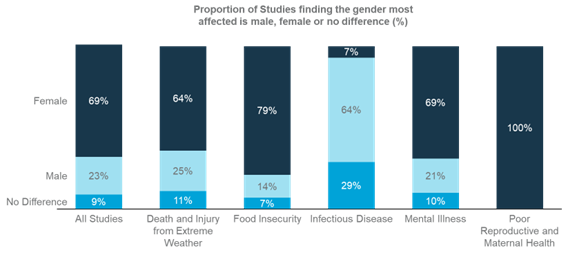
Furthermore, climate change disproportionately harms women’s health. In areas lacking access to clean water, women – who are typically responsible for water collection in 80% of households globally – face increased health risks. Climate-induced food insecurity worsens malnutrition, impacting women as primary caregivers and food providers in many cultures. They are also 14 times more likely to be injured or killed during extreme weather events. A CarbonBrief report analyzing 130 studies found women are 68% more susceptible to climate related health impacts like food insecurity and mental illness. Climate stress and displacement further exacerbate these issues, increasing the risk of gender-based violence. Limited access to credit, often due to land ownership restrictions, hinders women’s ability to invest in climate-resilient farming practices or water-saving technologies, further compounding their health vulnerabilities. Addressing these multifaceted challenges is essential to improve women’s health outcomes globally.
Lack of investment in women’s health translates not just to a disparity in outcomes, but a financial burden as well. Women in the U.S. spend a staggering $15 billion more annually on out-of-pocket healthcare than men. This disparity stems from a combination of factors: women are more likely to seek treatment, experience misdiagnosis due to a lack of gender-specific research and face a shortage of female doctors in many medical fields.
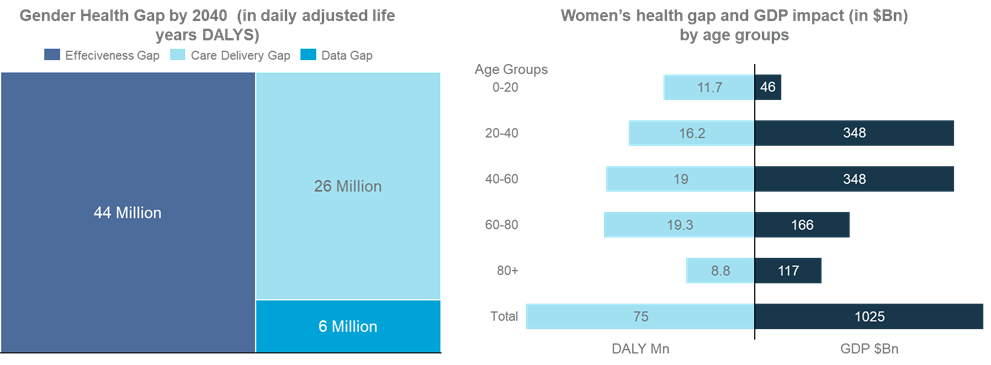
Closing the gender health gap could significantly boost the global economy by adding an estimated 1.7% to global GDP and $1 trillion annually by 2040. This translates to increased productivity and reduced disability across the workforce.
Source: McKinsey’ Closing the Women’s Health Gap
Source: CarbonBrief
How does FemTech support greater health equity?
FemTech’s impact on health equity goes beyond individual products. FemTech tackles systemic challenges by addressing inequities and access barriers faced by women, particularly in marginalized communities, and has evolved over time. Initially. FemTech funds focused on early-stage ventures and conditions like menstruation and menopause. Now these funds increasingly diversifying their investments by targeting a wider range of companies, from pre-seed to pre-IPO and addressing diverse needs by supporting solutions for conditions that primarily affect women, as well as those that impact women indirectly (e.g. non-hormonal birth control for men).
Applying a framework laid out in CapShift’s “A Healthy Future” primer, the FemTech investible universe can be viewed through the lens of Innovation, Care, and Prevention.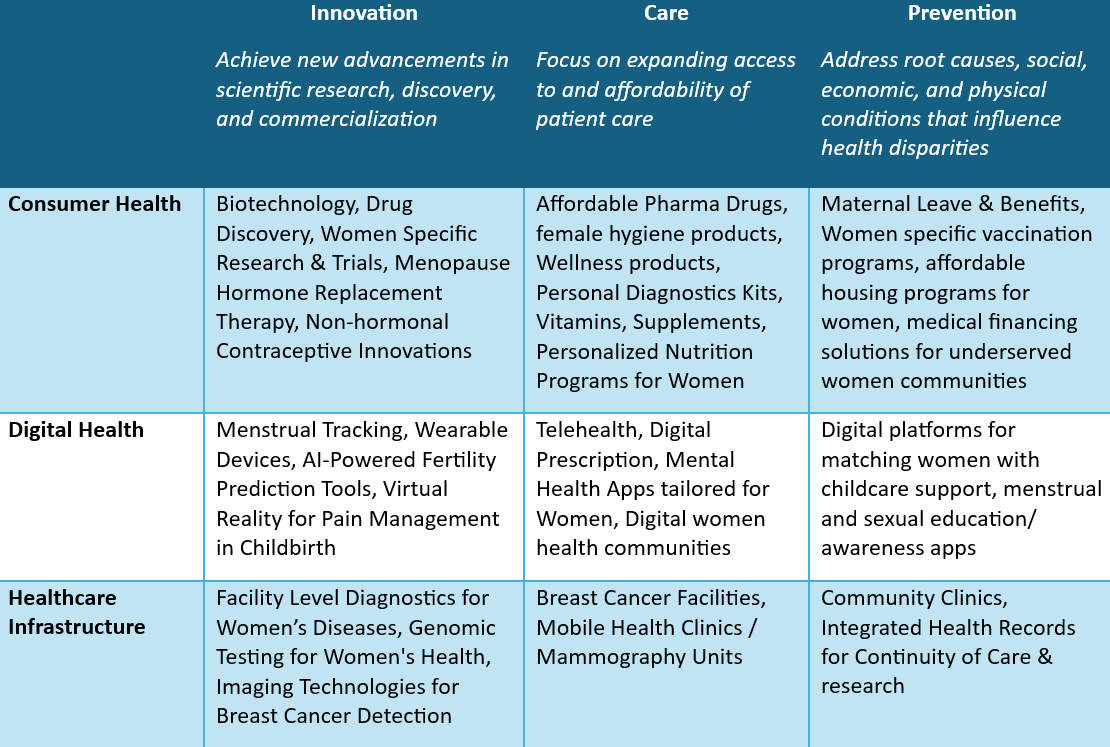
What are the different sources of capital for FemTech?
FemTech attracts investment from a variety of sources, including:
- Venture Capital: Venture funding in FemTech peaked in 2021 with $2.1 billion invested, primarily in women’s general health and wellness, reproductive health, and contraception.
- Private Equity: Firms are increasingly investing in FemTech startups and growth-stage companies focusing on innovative women’s health solutions.
- Public Markets: Public equity and fixed income investments, including women’s health bonds and ETFs, are emerging as vehicles for investing in FemTech.
- Recoverable Grants: Nonprofits or nonprofit-affiliated funds are increasingly tapping into charitable assets from foundations to donor advised funds for advancing high impact, catalytic FemTech solutions.
- Government Grants and Subsidies: Regulatory support and government initiatives, such as the White House Initiative on Women’s Health Research and the Menopause Research and Equity Act, provide crucial funding for FemTech innovations.
One example of a venture capital fund dedicated to addressing gaps in women’s health invests in early-stage startups developing innovative solutions for reproductive and maternal healthcare. Targeting contraception, maternal health, and health equity, they aim to impact millions of women and birthing individuals. Since its inception, the fund has deployed over $30 million, supporting startups that have reached over 1 million women. Beyond financial investment, this fund actively creates impact across numerous mentioned areas by:
- Building business cases for reproductive health public policy
- Developing frameworks for assessing health equity
- Working with corporations to implement maternal benefits policies
This holistic approach demonstrates how private capital can drive substantial social impact while pursuing strong financial returns, making FemTech a compelling choice for investors dedicated to women’s health advancement.
Why care about FemTech in the context of client portfolios?
For investors, FemTech is not just about social good; it also offers strong financial and economic potential. The sector is witnessing a rise in successful exits and mergers and acquisitions, as evidenced by high-profile transactions like the acquisitions of fertility startup Progyny and digital health tracker app, Flo. These exits not only validate FemTech business models but also demonstrate their ability to deliver market-rate returns.
FemTech investments currently represent an undervalued market with significant growth potential. Despite significant traction in private equity and venture capital funding, FemTech still represents a mere 3% of total digital health spending. This disparity stems from persistent stigma and a lack of understanding among some traditionally male dominated groups. Notably, men’s health issues like erectile dysfunction attract significantly more funding ($1.24 billion secured between 2019 and 2023) compared to conditions like endometriosis ($44 million), which disproportionately affect women.
However, as the ecosystem matures and attracts more corporate and healthcare providers, exit opportunities are expected to expand. Major pharmaceutical companies, including Merck, Pfizer, Johnson & Johnson are increasingly integrating FemTech into their corporate social responsibility and investment strategies, while governments, including Canada and Sweden, and NGOs like GAVI and Global Financing Facility are co-investing in global health funds. This influx of diverse capital creates a robust foundation for FemTech’s growth and provides multiple avenues for successful exits. By incorporating FemTech into client portfolios, financial advisors can offer a unique opportunity to drive positive social change while achieving financial returns. FemTech aligns with broader goals of promoting gender equality, improving healthcare access, and fostering economic empowerment – a trifecta of positive impact.
Conclusion
FemTech isn’t just a health revolution, it’s an investment opportunity. Despite a funding gap and ingrained biases, FemTech is poised for significant growth. By tackling unmet needs and fostering a more equitable healthcare landscape, FemTech offers potential for compelling financial returns alongside social good. For investors seeking to drive positive change while achieving strong profits, FemTech presents a unique chance to be part of the solution. By incorporating FemTech into client portfolios, advisors can empower women’s health, bridge the economic gap, and contribute to a healthier future for all.
About the Authors
Garima Gupta is a Manager of Impact Investments at CapShift. She collaborates with the investment research team and advisory practice to identify and assess investment opportunities aligned with social and environmental impact goals. Prior to joining CapShift, Garima practiced law in India. She holds a Master of International Business from The Fletcher School at Tufts University with a concentration in social finance.
Kawal Kohli is an Impact Investment Fellow at CapShift, where she supports the research team’s efforts in investment sourcing and diligence. She is passionate about exploring investment opportunities at the intersection of gender, health, and climate. She is currently pursuing her MBA at the UVA Darden School of Business. Prior to her MBA, she worked as a management consultant at Deloitte, designing and implementing transformation strategies for clients across industries.